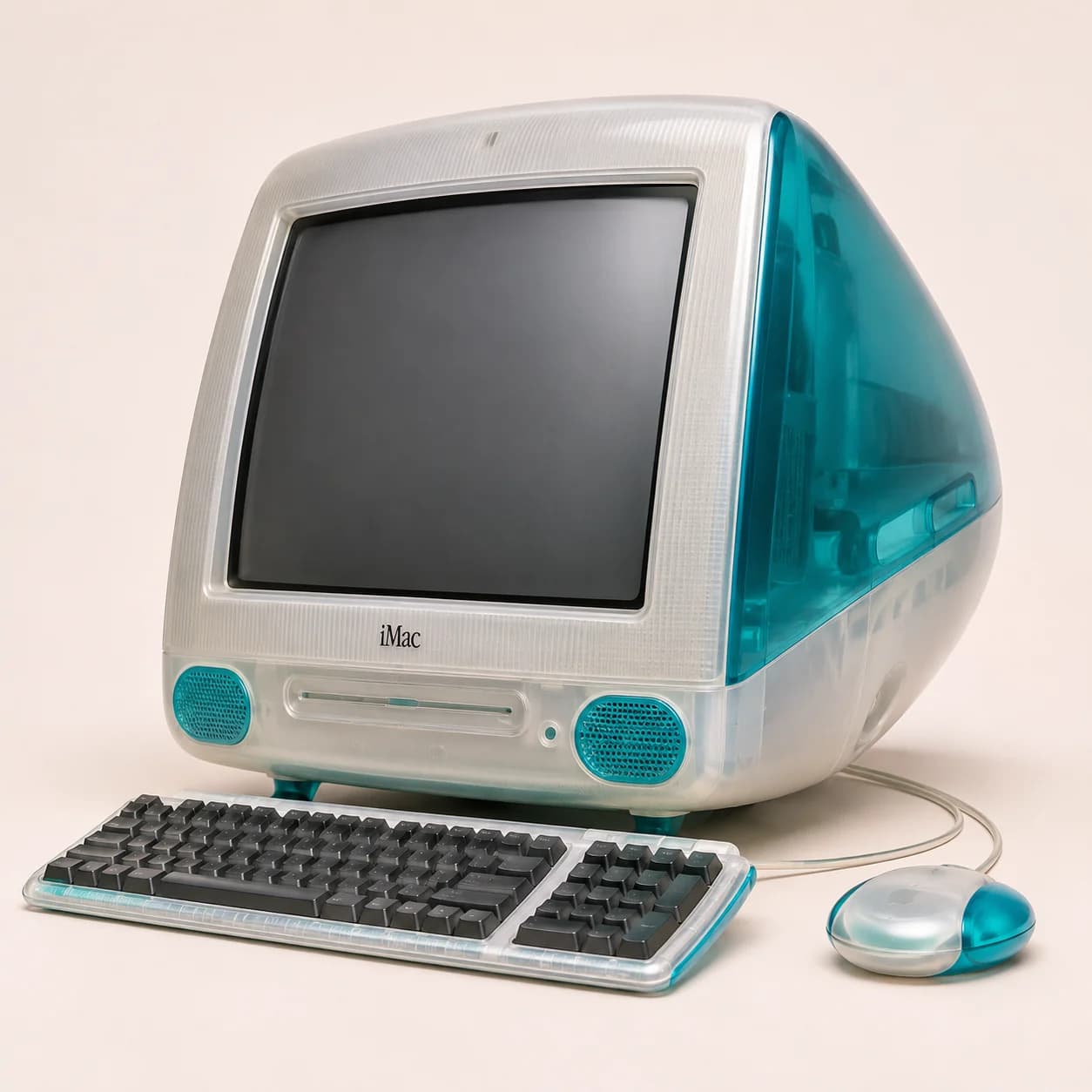
Genuine tech legend
No memories yet.
OBSOLET. index93 out of 100
Genuine historical products, satirical writing, nothing for sale at OBSOLET.Real devices, satirical writing — nothing for sale.
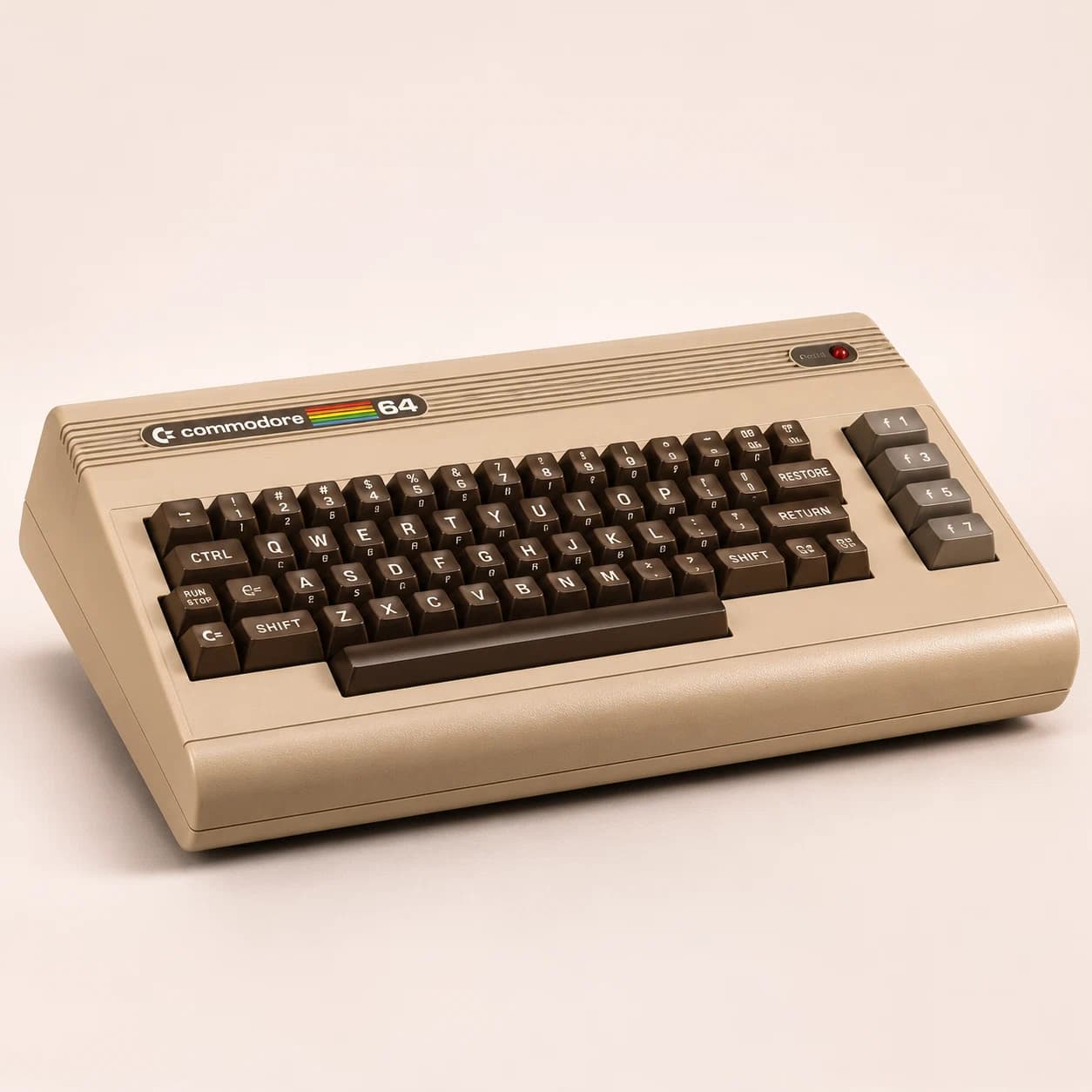
The depiction follows references and may differ in detail.
64 KB, and an entire hobby to fill them.
This device really existed. Maker, year and technical details are documented — only the price and the availability are invented.
Documented via: si.edu
A catalogue entry, not an offer. This device is not for sale here. What can be documented is next to it: the original price of the day with its source, and what that buys today. Anyone actually looking for the device will find real partner offers further down — where there are any.
Every task a home computer was bought for in 1982 is now handled by a telephone in passing.
A home computer that does not introduce itself on startup. It simply waits.
A MOS 6510 and 64 KB of memory added up to a machine one person could understand completely. There was no layer hiding another layer, and Commodore published the details: the Programmer's Reference Guide contained the computer's circuit diagram and a list of what sat at which memory address. Finding out what the machine was doing required no secret, only a register.
Audio came from a dedicated component, the SID: three voices, each with its own waveform and envelope, plus a shared filter. It was designed by Bob Yannes, who shortly afterwards co-founded Ensoniq and built professional synthesizers. A home computer's sound chip thus came from someone who actually wanted to build an instrument. You can hear it.
Programs arrived from cassette or disk drive. Both took time; tape took a great deal of it. The 1541 floppy was slow for a precise reason: the fast transfer method had been designed around the shift register of the 6522 in the drive, and that shift register was faulty. The transfer had to be rebuilt in software, bit by bit, and stayed that way for compatibility. The waiting was therefore not a philosophy but a component that did not do what the design said it would.
The expansion port exposes the system bus: addresses, data, and the lines a cartridge uses to claim the computer's memory for itself. A cartridge can switch off BASIC and take over the machine completely at power-on. The openness was deliberate, and it had the side effect that expansions worked without the manufacturer needing to know they existed.
The best-selling home computer of its era, and today chiefly evidence that being comprehensible was once a product feature.
An editorial assessment, not a documented fact. The sections above carry the evidence.
Every task a home computer was bought for in 1982 is now handled by a telephone in passing.
The video output fits no current television, the media have disappeared, and after forty years the power supply is the commonest reason a working machine dies.
Learning to program on a machine you can understand completely — and for music, since the SID chip still sounds like nothing else.
An editorial assessment, not a measurement: how completely has this device’s job been taken over by something else?
An editorial comparison: which job was taken over, and what falls away with it.
Editorial assessment. No paid placement, no partner link, no price comparison.
Two devices, one decision, no winner
| Specifications | ||
|---|---|---|
| 95 out of 100 | OBSOLET. index | 93 out of 100 |
| 1982 | Year | 1998 |
| No longer available | Availability | No longer available |
| Commodore | Brand | Apple |
What someone wants to know when picking the device up today. The answers are dry, but not invented.
Because you clearly have taste
Documented via: Heinz Nixdorf MuseumsForum, Blogbeitrag „Das war der Commodore 64“ (04.08.2022)
Caveat: Taken from a secondary source. No contemporary primary document for this figure.
Note: Given consistently by the Heinz Nixdorf MuseumsForum (“in January 1983 for 1,495 DM”) and by 8bit-museum.de (“early 1983 for 1495 DM”). Both are editorial articles with no reference to a contemporary primary document for this amount. The price fell sharply within the same year: the magazine Hobby Computer gave 675 DM in November 1983, and SPIEGEL between 600 and 700 DM in December 1983.
Approximation: the calculation crosses the 1991 territorial break. Until 1990 the official series covers West Germany only; from 1991 it covers unified Germany.
Official series of the Federal Statistical Office of Germany. D-Mark amounts at the fixed rate of 1 EUR = 1.95583 DM, then adjusted using the consumer price index.
Documented via: Heinz Nixdorf MuseumsForum, Blogbeitrag „Das war der Commodore 64“ (04.08.2022)
Caveat: Taken from a secondary source. No contemporary primary document for this figure.
Note: Announced at CES in January 1982, on sale in the United States from September 1982. Also given by 8bit-museum.de. No purchasing-power equivalent is shown for this amount: a US price must not be projected forward with the German consumer price index.
No purchasing-power equivalent: A price for the US market. The German consumer price index does not apply to it, and the index for that country is not available here.
The purchasing-power equivalent states what sum would carry the same general purchasing power today. It is not a current market price, not a retail price and not a collector's value.
Current listings from external marketplaces. OBSOLET. sells none of them — every link goes to the respective seller.
No matching listing found right now. The technology is evidently ahead of its time again.
Checked at 23/11/2026, 20:09. As soon as something appears, it will be here.
We do not search Kleinanzeigen automatically — but you can set up a saved search there yourself.
No memories yet.
Be the first.
Browsing listings needs no account. An alert keeps running on the server while you are away — that is what needs a sign-in.
Sign in