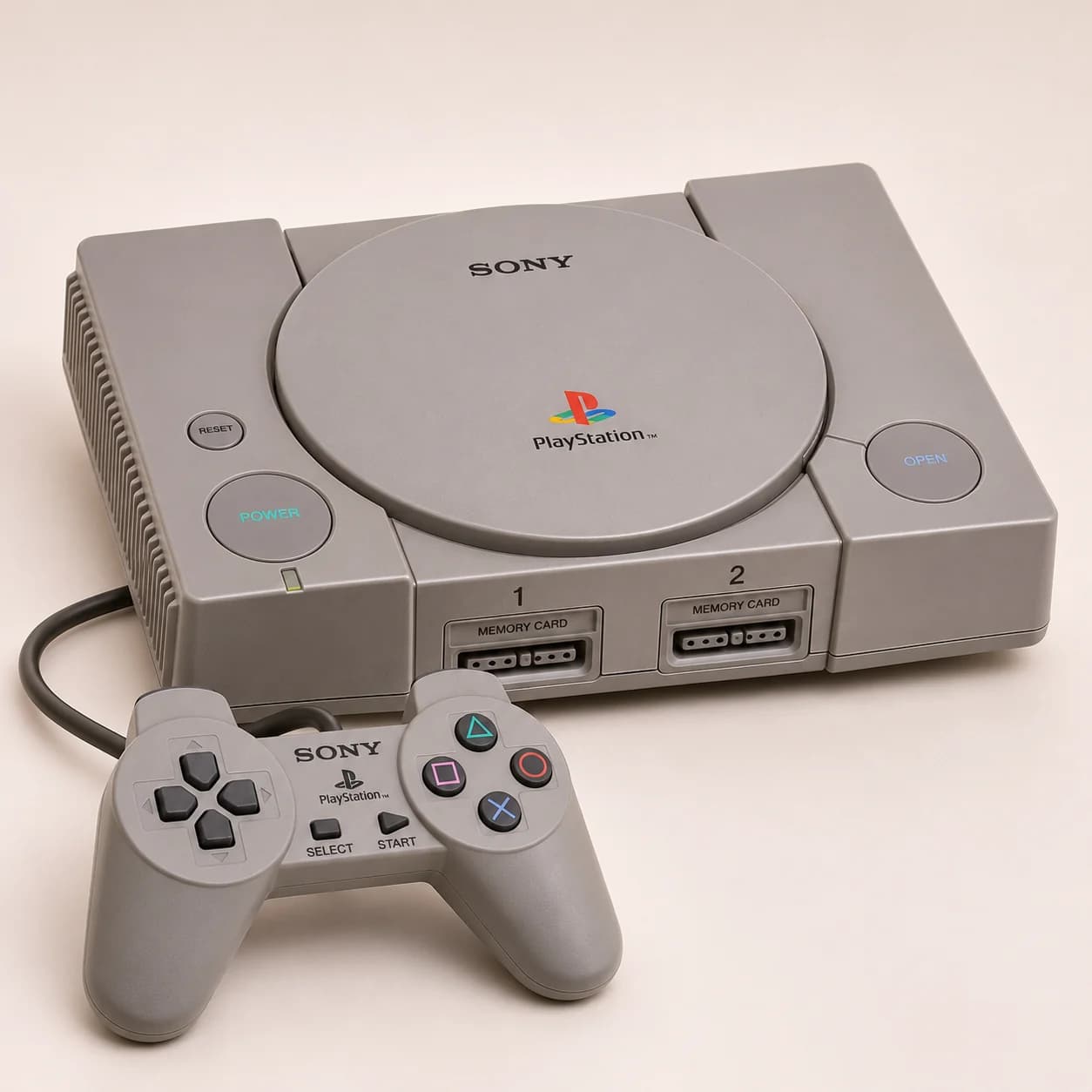
Genuine tech legend
No memories yet.
OBSOLET. index88 out of 100
Genuine historical products, satirical writing, nothing for sale at OBSOLET.Real devices, satirical writing — nothing for sale.
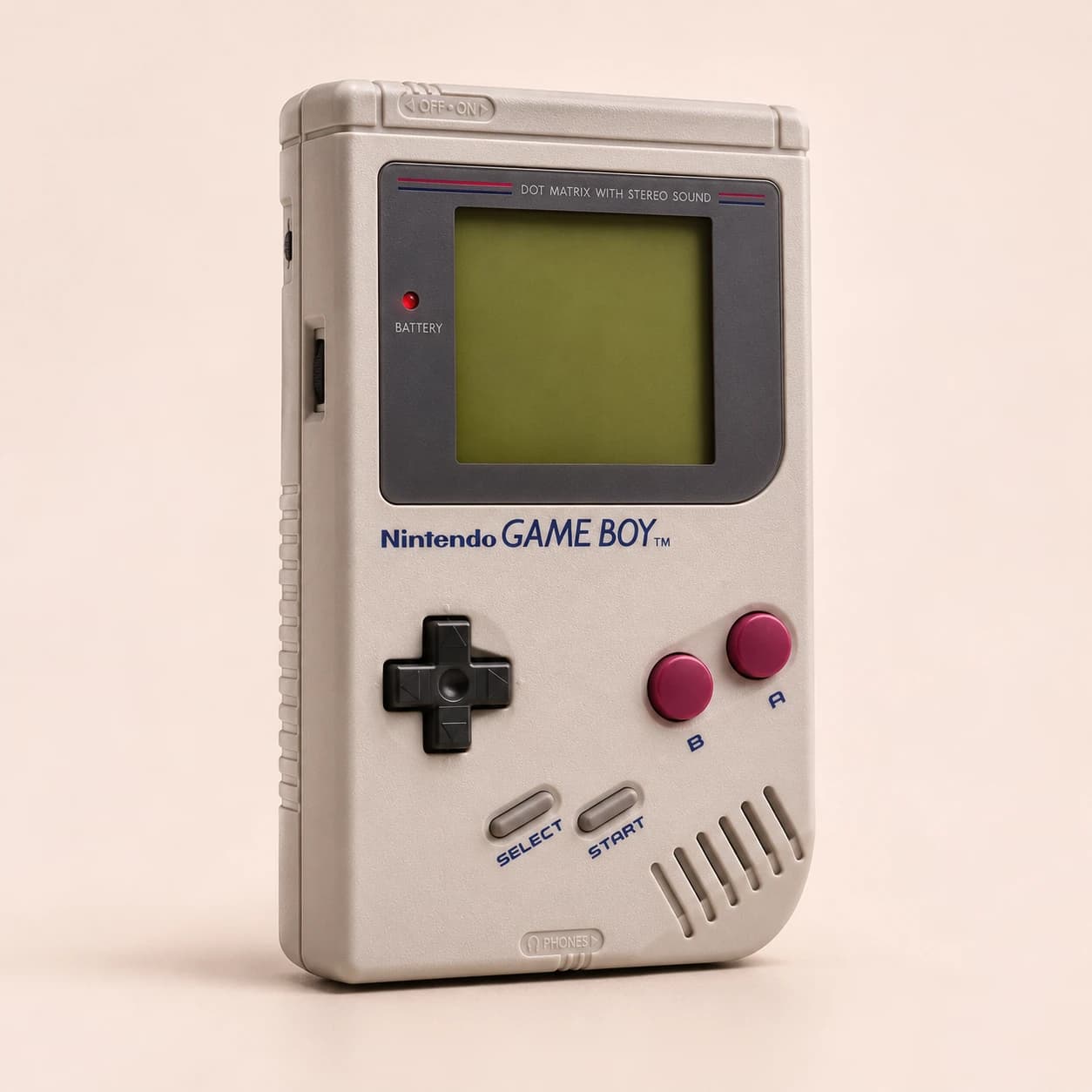
The depiction follows references and may differ in detail.
Four shades of grey. No background apps.
This device really existed. Maker, year and technical details are documented — only the price and the availability are invented.
Documented via: nintendo.com
A catalogue entry, not an offer. This device is not for sale here. What can be documented is next to it: the original price of the day with its source, and what that buys today. Anyone actually looking for the device will find real partner offers further down — where there are any.
As a games machine the Game Boy is outclassed by every telephone.
Technically weaker than its rivals, and still the one that was left standing.
The screen renders four steps between light and dark. Colour handhelds existed, and they drained batteries at a rate to match. Choosing against colour is the reason this one survived an entire train journey on four AA cells while the competition did not.
The display has no light source of its own. It reflects whatever is available. Playing after dark meant finding a lamp, or waiting in the car for the next street light. Modern devices glow on their own and then remind you in the evening that perhaps they should not.
Games live in a cartridge. Wanting a different game meant swapping it — completely, with no loading bar and no update before launch. A cartridge you owned stayed playable whether or not anyone was still running a server for it.
Playing together required a link cable. It worked in exactly one situation: when both people were in the same room. No friends list was necessary, because the reach of the friendship was defined by the length of the cable.
Obsolete as a games machine, instructive as an engineering decision: the weaker hardware won because it kept going.
An editorial assessment, not a documented fact. The sections above carry the evidence.
As a games machine the Game Boy is outclassed by every telephone.
It is also the device in this catalogue that has broken down least: cartridges work, the screen has no backlight to lose, and four AA cells are available anywhere. What ages is the backup battery inside the cartridges.
Playing without an account, an update or an internet connection — and as one of the few devices a child can operate without breaking anything.
An editorial assessment, not a measurement: how completely has this device’s job been taken over by something else?
An editorial comparison: which job was taken over, and what falls away with it.
Editorial assessment. No paid placement, no partner link, no price comparison.
Two devices, one decision, no winner
| Specifications | ||
|---|---|---|
| 78 out of 100 | OBSOLET. index | 88 out of 100 |
| 1989 | Year | 1994 |
| No longer available | Availability | No longer available |
| Nintendo | Brand | Sony |
What someone wants to know when picking the device up today. The answers are dry, but not invented.
Because you clearly have taste
Documented via: DeWiki, Artikel „Game Boy“ (Wikipedia-Spiegelung)
Caveat: Taken from a secondary source. No contemporary primary document for this figure.
Note: German market launch on 28 September 1990 at 169 DM. One diverging source gives “around 150 marks”; 169 DM is quoted more often and with a date. A purchasing-power equivalent is shown for this amount — 1990 lies before the start of the all-German index series, so the calculation builds on the West German series.
Approximation: the calculation crosses the 1991 territorial break. Until 1990 the official series covers West Germany only; from 1991 it covers unified Germany.
Official series of the Federal Statistical Office of Germany. D-Mark amounts at the fixed rate of 1 EUR = 1.95583 DM, then adjusted using the consumer price index.
Documented via: DeWiki, Artikel „Game Boy“ (Wikipedia-Spiegelung)
Caveat: Taken from a secondary source. No contemporary primary document for this figure.
Note: Japanese market launch on 21 April 1989 at 12,500 yen. The yen has no subunit; the two decimal places are a property of the display, not of the price. No purchasing-power equivalent is shown for this yen amount.
No purchasing-power equivalent: A price for the JP market. The German consumer price index does not apply to it, and the index for that country is not available here.
The purchasing-power equivalent states what sum would carry the same general purchasing power today. It is not a current market price, not a retail price and not a collector's value.
Current listings from external marketplaces. OBSOLET. sells none of them — every link goes to the respective seller.
No matching listing found right now. The technology is evidently ahead of its time again.
Checked at 23/11/2026, 20:09. As soon as something appears, it will be here.
We do not search Kleinanzeigen automatically — but you can set up a saved search there yourself.
No memories yet.
Be the first.
Browsing listings needs no account. An alert keeps running on the server while you are away — that is what needs a sign-in.
Sign in