Genuine tech legend
No memories yet.
OBSOLET. index78 out of 100
Genuine historical products, satirical writing, nothing for sale at OBSOLET.Real devices, satirical writing — nothing for sale.
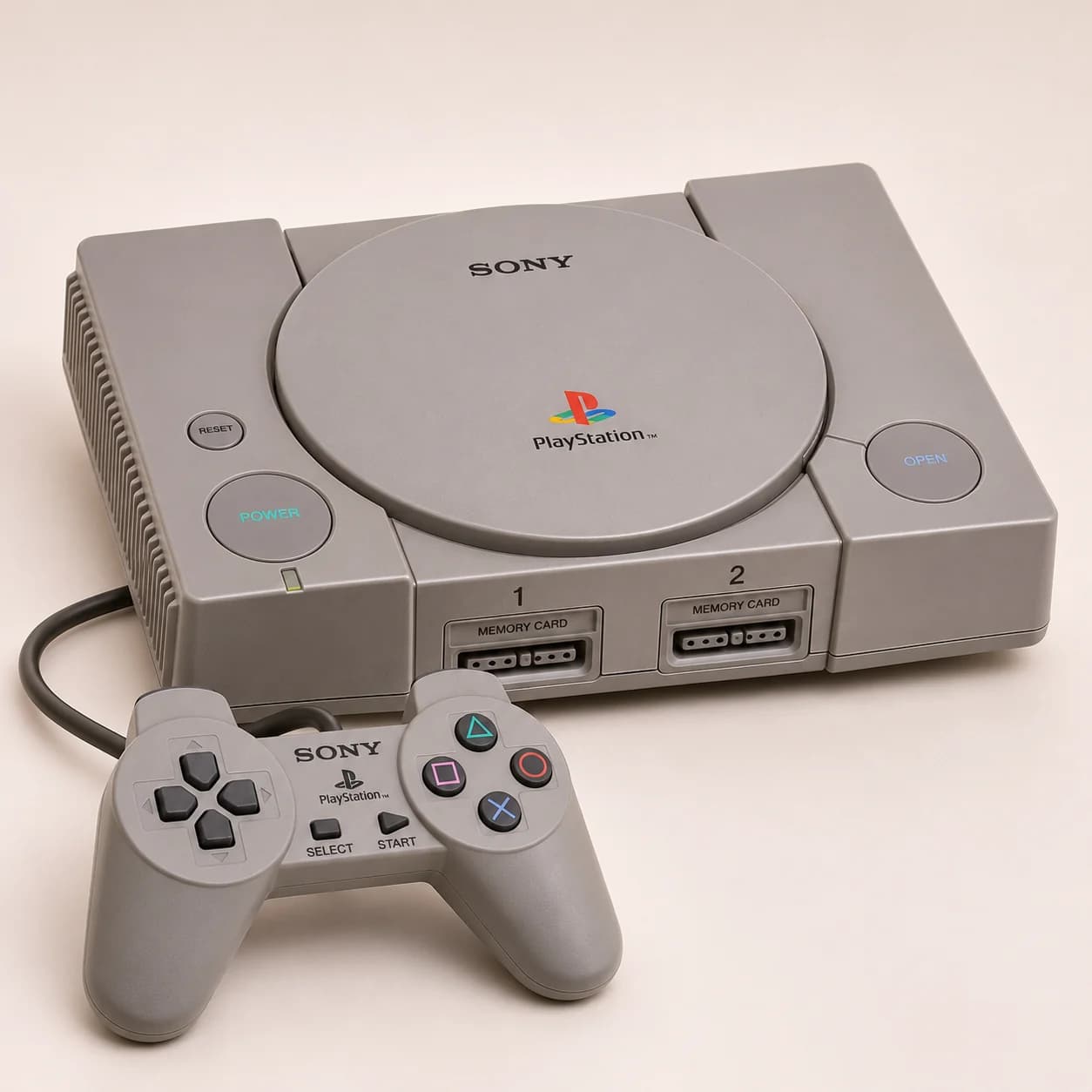
The depiction follows references and may differ in detail.
Three dimensions, one cable to the television.
This device really existed. Maker, year and technical details are documented — only the price and the availability are invented.
Documented via: playstation.com
A catalogue entry, not an offer. This device is not for sale here. What can be documented is next to it: the original price of the day with its source, and what that buys today. Anyone actually looking for the device will find real partner offers further down — where there are any.
Three-dimensional games have moved on through three console generations, and the CD has left the living room.
The console that moved three-dimensional games from the arcade into the living room, loading times included.
The disc held far more than a cartridge, which made full-motion video and recorded music possible. It also had to be read before anything could be played. Loading became a fixed part of gaming and a dependable excuse to fetch a drink.
Progress lived on a memory card you inserted, removed and carried. It belonged to whoever was holding the card. There was no sign-in and no cloud reconciliation — and a save you lost was lost for good.
The original pad had a directional cross and buttons, but no sticks. In games built around moving freely through space, this was noticeable. The fix arrived afterwards as an accessory: the Dual Analog in April 1997, the DualShock in November of the same year, after which Sony discontinued the older pads. The console had thus been on sale for three years before it acquired the controller it is remembered by.
The console traces back to a joint project with Nintendo: a CD add-on for their machine that fell apart shortly before it was due to be shown. Sony carried on alone. The most successful games device of its generation therefore emerged not from a plan but from the remains of one.
Outperformed by anything made today. Valuable mainly as evidence that a save file was once a physical object you could misplace.
An editorial assessment, not a documented fact. The sections above carry the evidence.
Three-dimensional games have moved on through three console generations, and the CD has left the living room.
The console itself ages in two places: the laser diode weakens, and memory cards eventually lose their contents.
Games that were never re-released, on the hardware they were written for — loading times included.
An editorial assessment, not a measurement: how completely has this device’s job been taken over by something else?
An editorial comparison: which job was taken over, and what falls away with it.
Editorial assessment. No paid placement, no partner link, no price comparison.
Two devices, one decision, no winner
| Specifications | ||
|---|---|---|
| 88 out of 100 | OBSOLET. index | 78 out of 100 |
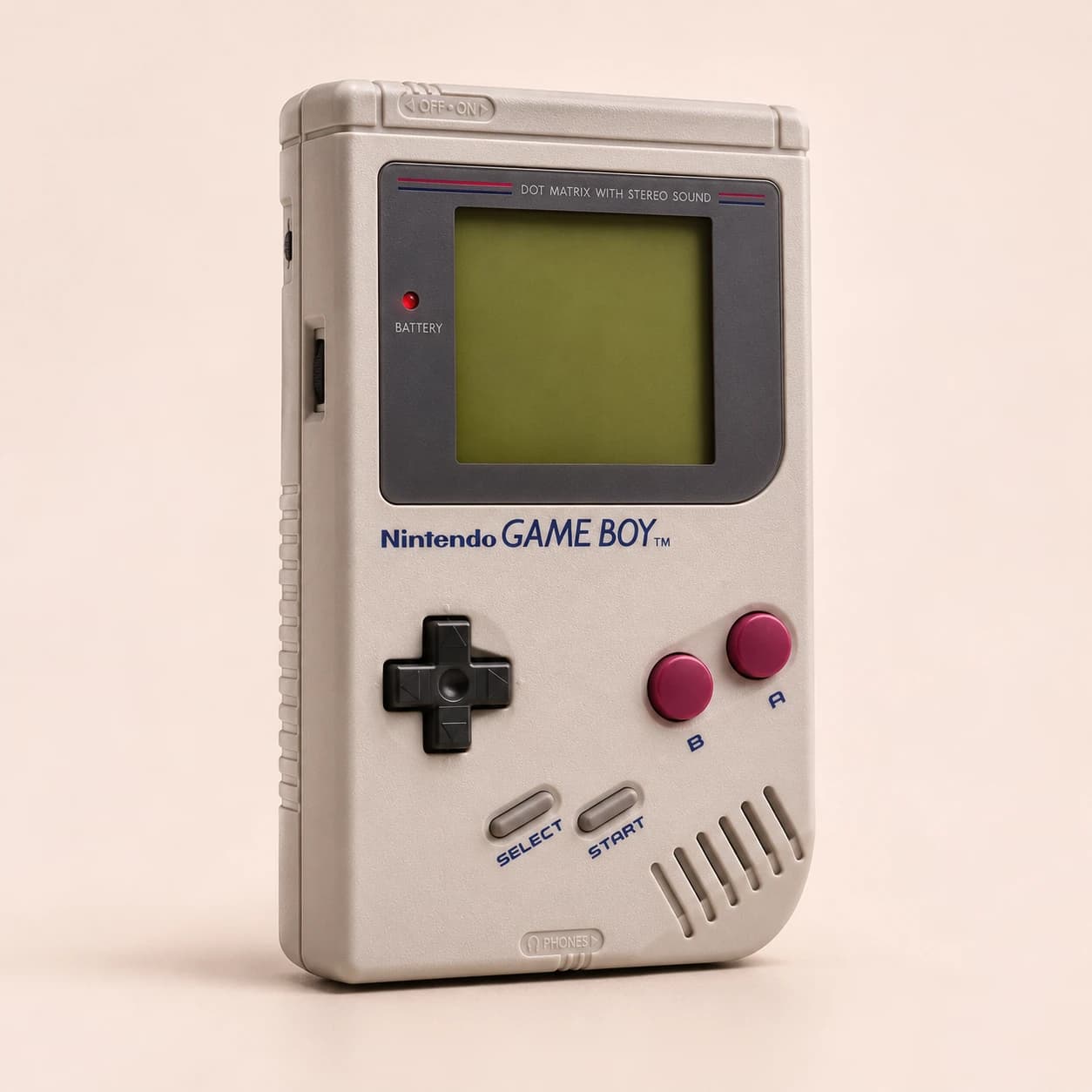
| 1994 | Year | 1989 |
| No longer available | Availability | No longer available |
| Sony | Brand | Nintendo |
What someone wants to know when picking the device up today. The answers are dry, but not invented.
Because you clearly have taste
Documented via: Duckipedia, Artikel „PlayStation“
Caveat: Taken from a secondary source. No contemporary primary document for this figure.
Note: German market launch on 29 September 1995 at 599 DM. A further source gives “just under 600 DM”. A purchasing-power equivalent is shown for this amount.
Official series of the Federal Statistical Office of Germany. D-Mark amounts at the fixed rate of 1 EUR = 1.95583 DM, then adjusted using the consumer price index.
Documented via: Wikipedia (englisch), Artikel „PlayStation (console)“
Caveat: Taken from a secondary source. No contemporary primary document for this figure.
Note: US market launch on 9 September 1995 at 299 dollars. The Japanese launch price of 3 December 1994 was 39,800 yen; it is not carried here as a separate entry because the conversions in the sources differ widely (450 DM and 573 DM respectively). No purchasing-power equivalent is shown for this dollar amount.
No purchasing-power equivalent: A price for the US market. The German consumer price index does not apply to it, and the index for that country is not available here.
The purchasing-power equivalent states what sum would carry the same general purchasing power today. It is not a current market price, not a retail price and not a collector's value.
Current listings from external marketplaces. OBSOLET. sells none of them — every link goes to the respective seller.
No matching listing found right now. The technology is evidently ahead of its time again.
Checked at 23/11/2026, 20:09. As soon as something appears, it will be here.
We do not search Kleinanzeigen automatically — but you can set up a saved search there yourself.
No memories yet.
Be the first.
Browsing listings needs no account. An alert keeps running on the server while you are away — that is what needs a sign-in.
Sign in